
Guide
What is a longevity check-up?
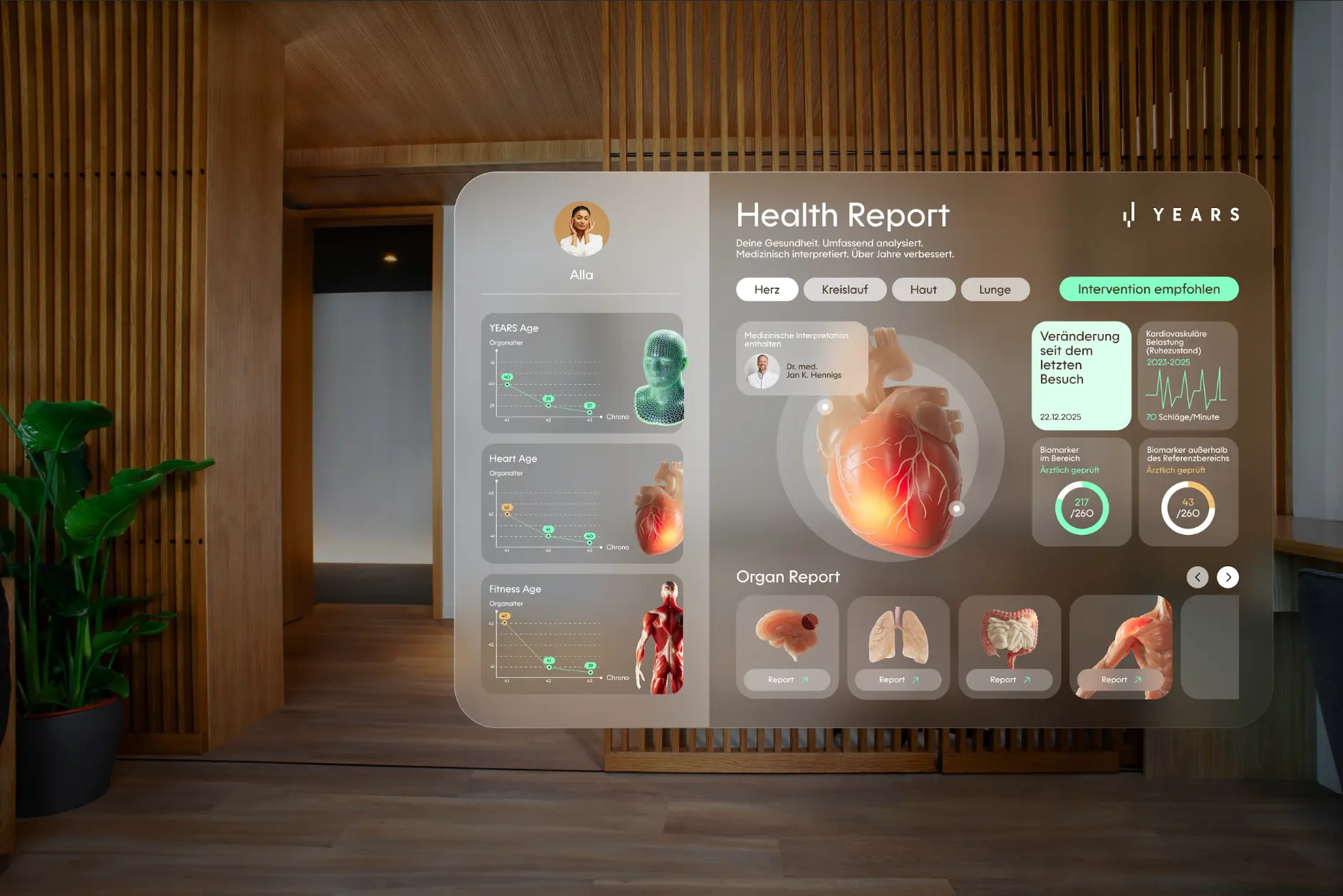
An in-depth medical assessment that measures risk factors for age-related disease before symptoms appear. The aim is not to diagnose an existing illness but to quantify your biological age and your individual risk trajectory, and to derive a prevention plan you can verify over time.
- 87 to 230+ biomarkers
- Whole-body MRI
- Spiroergometry & vascular ultrasound
- Optional genetics & liquid biopsy
Definition
The term “longevity check-up” describes a standardised preventive diagnostic programme that goes beyond statutory screening. It focuses on three levels:
- Early detection: Aneurysms, tumours, vascular changes, metabolic disorders and organ changes, before they become clinically apparent.
- Risk quantification: Measuring modifiable risk factors such as ApoB, Lp(a), HOMA-IR, VO2max, bone density, cognitive performance and inflammatory markers.
- Intervention and monitoring: Deriving an individual prevention plan (nutrition, training, sleep, supplementation, medication where indicated) and tracking it longitudinally.
Longevity check-up vs. the statutory Check-up 35 in Germany
Both have their place. But they answer different questions.
Blood values
Check-up 35
~5 (cholesterol, blood glucose)Longevity
87 to 230+ biomarkersImaging
Check-up 35
NoneLongevity
Whole-body MRI from EvolveCardiovascular
Check-up 35
Blood pressureLongevity
ECG + echo + vascular ultrasound + spiroergometryCancer screening
Check-up 35
Age-based screeningsLongevity
MRI + liquid biopsy from EvolveEpigenetics
Check-up 35
Not availableLongevity
DunedinPACE, GrimAge from UltimateDuration
Check-up 35
20 to 30 minLongevity
6 to 10 hoursSix domains of a longevity check-up
The specific scope varies between providers. A complete check-up addresses these six areas.
1. Blood biomarkers
Lipid profile including ApoB and Lp(a), inflammatory markers (hsCRP, IL-6), glucose and insulin metabolism (HOMA-IR, HbA1c), thyroid, sex and stress hormones, vitamins, trace elements, liver and kidney function.
2. Heart & circulation
ECG, stress ECG, echocardiography, vascular ultrasound with Doppler, blood pressure profile, HRV. Reveals structural changes and early atherosclerosis.
3. Fitness & metabolism
Spiroergometry (VO2max) as one of the strongest predictors of mortality. Bone density, grip strength, body plethysmography, body composition.
4. Imaging
Whole-body MRI with a preventive protocol. High-resolution imaging of brain, spine, thorax, abdomen and pelvis. Radiation-free. Can reveal clinically silent tumours, aneurysms and organ changes.
5. Cognition & mental health
Neurocognitive tests for attention, working memory and executive function. Validated questionnaires on stress, sleep and mood. Optional dementia screening.
6. Molecular clocks
Epigenetic age estimation (DunedinPACE, GrimAge), genome sequencing to identify relevant variants, microbiome analysis and liquid biopsy for multi-cancer early detection.
Why a longevity check-up makes sense today
Four of the five most common causes of death in Germany are age-related and to a large extent modifiable: cardiovascular disease, cancer, metabolic disease and neurodegenerative disease. For each of these groups there are measurable risk factors detectable years to decades before symptoms begin.
At the same time, diagnostic depth that used to be available only in research studies is now clinically accessible: high-resolution MRI, multi-cancer liquid biopsy, epigenetic clocks, spiroergometry with precise VO2max determination, and extensive biomarker panels.
A longevity check-up combines both developments: measurable early signals plus structured intervention. The aim is not to live forever, but to maximise healthy, active years.
Common questions about the longevity check-up
A longevity check-up is an in-depth medical assessment that quantifies measurable risk factors for age-related conditions — cardiovascular disease, cancer, metabolic disorders and neurodegenerative processes — and derives an individual prevention plan from the results, before symptoms appear.
The statutory Check-up 35 in Germany covers blood pressure, blood glucose, cholesterol and a basic medical history. A longevity check-up goes considerably deeper: 87 to 230+ biomarkers, whole-body MRI, spiroergometry (VO2max), vascular ultrasound, cognitive testing, and optionally genetics and liquid biopsy. The aim is not only to identify acute disease but to quantify your biological age and your risk trajectory.
Six domains are usually covered: 1) a comprehensive blood panel with inflammatory markers, hormones, metabolic parameters and nutrient status, 2) cardiovascular diagnostics with ECG, echocardiography and vascular ultrasound, 3) lung function and spiroergometry, 4) imaging, usually as whole-body MRI, 5) neurocognitive testing, 6) optionally genetics, epigenetics, microbiome and multi-cancer liquid biopsy. The specific scope varies between providers.
Chronological age in years says little about how fast your body is actually ageing. Biological age is estimated using validated biomarkers: epigenetic clocks such as DunedinPACE and GrimAge, telomere length, inflammatory markers and organ function parameters. A longevity check-up measures these values and shows whether you are biologically younger or older than your year of birth would suggest. That information makes interventions verifiable.
The individual components are very well established. Risk factors such as ApoB, Lp(a), HbA1c, VO2max and blood pressure are considered robust predictors of morbidity and mortality. Whole-body MRI has been validated in studies as an early detection tool (for example Lancet 2023). Epigenetic clocks are methodologically well established. The overall effect of a combined check-up on life expectancy is currently being investigated in long-term studies. A serious longevity provider makes no promises of cure here, but works with the best evidence currently available.
For most adults between 35 and 65, an annual or biennial rhythm makes sense. Biomarkers change gradually, and only longitudinal data reveals reliable trends. Interventions such as dietary change, a training plan or medication need 3 to 12 months before an effect becomes measurable. For higher-risk patients, or following an intervention, shorter intervals can be appropriate.
The latest sensible starting point is the mid-thirties. At that stage measurable changes begin in ApoB, insulin resistance, vascular elasticity and lung function. Many of these values still respond well to intervention at that age. With a family history of early heart attacks, cancer or dementia, a check-up is defensible from the mid-twenties onwards.
Longevity check-up at YEARS in Berlin
87 to 230+ biomarkers, whole-body MRI from Evolve, physician-led care. From €1,990.