
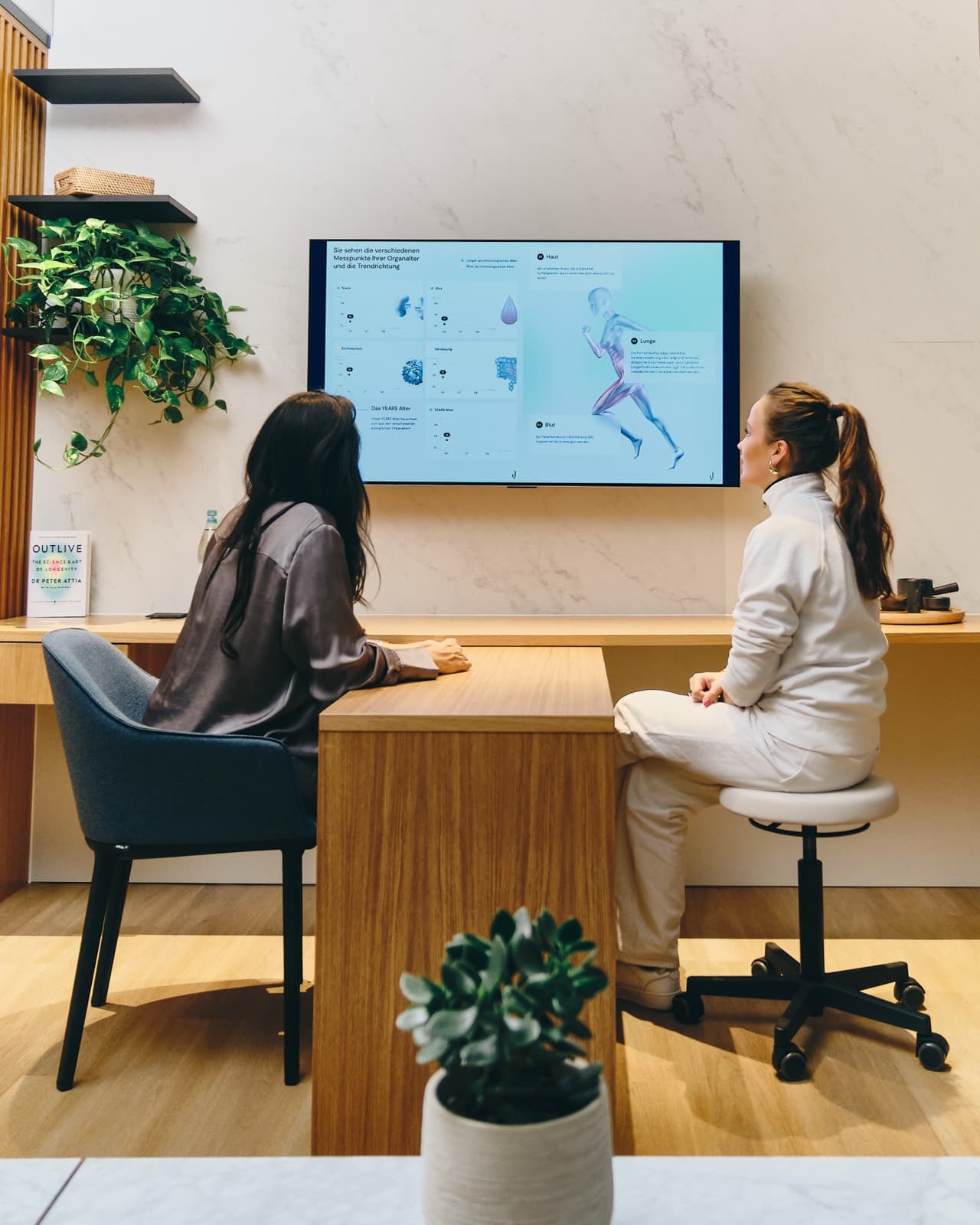
The part everything leads to
How does the results consultation work?
60 minutes with a specialist, on the afternoon of the examination day. Not a data export and not a portal notification, but interpretation, priorities and something written to take away. This page describes what happens in those 60 minutes.
60 min
in-person consultation with a specialist
2
appointments: on the day and after 2-3 weeks
0
findings delivered without interpretation
The short answer
A conversation, not a data delivery
The results consultation takes place on the afternoon of the examination day, lasts 60 minutes and is held in person with a specialist. It has four parts: interpretation of the findings, risk analysis in the context of your history, a prevention plan with a clear order of priority, and written documentation to take away.
For the values that take longer, a second consultation usually follows after two to three weeks. The reason for that split is not appointment logistics but the laboratory.
The four parts
What the 60 minutes consist of
Interpretation rather than reading out values
A value outside the reference range is not a finding but a reason for interpretation. So what gets discussed is not the list but what stands out, how certain that is and which explanations may sit behind it. Values that mean nothing are named as such rather than inflated.
Risk analysis in context
Individual findings are set against family history, previous results, medication and life circumstances. Only from that does an assessment emerge that says more than any single value on its own. Anyone who brought previous findings gets a trend here for the first time rather than a snapshot.
A prevention plan with an order
The most important part, and the most frequently underestimated. Not everything at once but an order: what matters now, what gets monitored and what can wait. A plan naming twenty items does not get implemented. One with three priorities does.
Written documentation to take with you
The consultation does not end verbally. You receive the findings and the interpretation in writing, so they can be passed on, to a GP, a specialist or a later treatment. Along with the GOÄ invoice, which you can submit to private health insurance.
Two appointments, not one
On the afternoon of the examination day
The results consultation, 60 minutes
Everything available on the same day is discussed here: history, functional diagnostics, imaging and the rapidly available laboratory values. In person, with a specialist, not via a portal notification.
Usually after 2 to 3 weeks
The strategy consultation on specialist laboratory results
Genetics, liquid biopsy and specialist laboratory work take longer. Once everything is in, a second appointment follows, by video on request. Here the plan from the first consultation is checked against the complete data and adjusted.
Afterwards
Follow-up, depending on the program
The extent of further follow-up differs between the programs. Core includes no ongoing check-ins, Evolve and Ultimate do. What is included in your program is set out on the respective program page and clarified in the intro call.
What an abnormal finding sets off in practice and how often that happens is set out on incidental findings. How long the examination day beforehand takes is set out on health check duration.
Common questions about the results consultation
It takes place on the afternoon of the examination day, lasts 60 minutes and is held in person with a specialist. Everything available at that point is discussed: history, functional diagnostics, imaging and the rapidly available laboratory values. The consultation has four parts: interpretation of the findings, risk analysis in the context of your history, a prevention plan with a clear order of priority, and written documentation to take away. The GOÄ invoice comes with it. A second appointment follows for the specialist laboratory results, usually after two to three weeks.
An abnormal finding is a reason for work-up here and never a diagnosis. In the consultation we assess how likely the finding is to mean something, which explanations may sit behind it and what the sensible next step is. The work-up itself continues within specialist standard care, which is where we hand over along with the written documentation. We do not replace that path and deliberately offer no procedure whose purpose is to keep a finding in-house. How often broad diagnostics finds something nobody was looking for is documented with figures and sources on a page of its own.
The findings and the medical interpretation of them, plus the prevention plan. The reason for putting it in writing is practical: the documents should be shareable, with your GP, a specialist or a later treatment. A finding that exists only verbally is worthless over time. Along with it comes the invoice under the German medical fee schedule, which you can submit to private health insurance. What gets reimbursed depends on your policy and cannot be promised in general beforehand.
Yes, if you want that. Many find it helpful, because a great deal of information comes together in 60 minutes and two people retain more than one. The decision is explicitly yours and is made on the day itself, not beforehand by someone else. If a finding is very personal, the consultation can also be held in sections without the accompanying person. Just raise it at the start and the process will be set up accordingly.
Because not all values are available at the same speed. A standard blood count is available within hours and can be discussed the same afternoon. Genetic analyses, liquid biopsy and certain specialist laboratory values, by contrast, go through multi-stage procedures in external specialist laboratories. That time cannot be shortened without degrading what the result can tell you. The second appointment is therefore not an addendum but the point at which the plan from the first consultation is checked against the complete data. It takes place in person or by video.
Read on
What happens before and after the consultation.
Health check duration
6 to 9 hours, and where those hours go.
Incidental findings
How often something turns up that nobody was looking for.
The report
How the results are documented and presented.
Whole-body check-up
The full examination scope, procedure by procedure.
Reimbursement
What the GOÄ invoice is and how submission works.
Evidence
Why a finding here never automatically triggers treatment.

Questions about the process before you book?
15 minutes, free of charge. We walk through the process and will also tell you when a program adds little in your situation.
★ 4,9 · 71+ Google-reviews · PKV, Beihilfe & bKV reimbursable