

Berlin-Charlottenburg · Spiroergometry
VO2max in Berlin, measured, not estimated.
Your maximal oxygen uptake is one of the best-evidenced predictors of life expectancy, and one of the few you can actually change through training. We measure it by spiroergometry with concurrent ECG, and interpret the value alongside the rest of your diagnostics.
Directly measured
breath-by-breath gas analysis, no formula
With ECG
cardiac assessment in parallel
Part of Core
from €1,900, all in one day
Overview
The VO2max test at YEARS at a glance
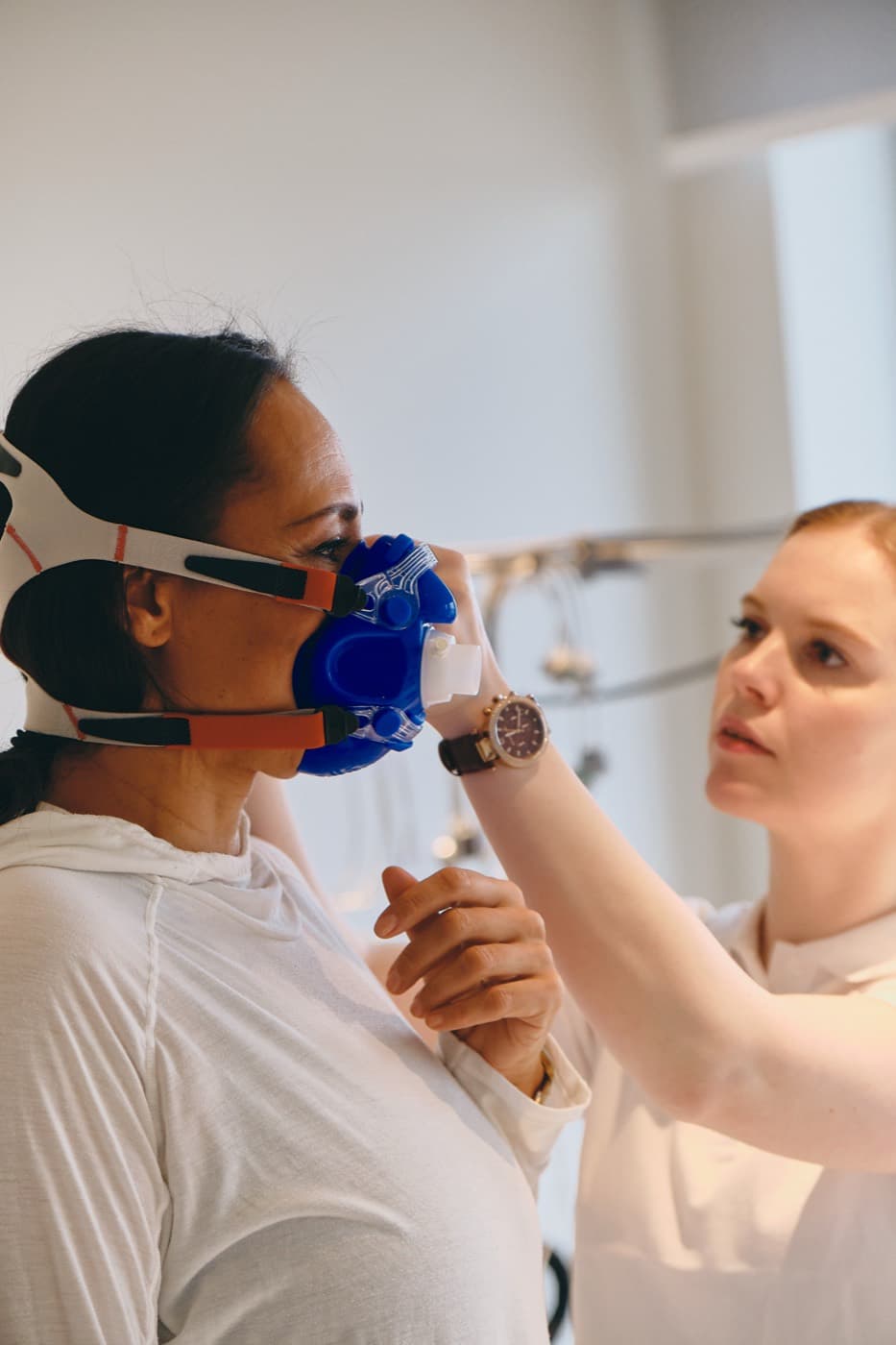
VO2max is the maximum amount of oxygen your body can use under exertion, expressed in millilitres per kilogram of body weight per minute. It is measured by spiroergometry: you cycle or run under stepwise increasing load while a breathing mask continuously records oxygen uptake and carbon dioxide output, with ECG and blood pressure monitored throughout. This is a directly measured value, not a model derived from heart rate. At YEARS, spiroergometry is part of the Core program in Berlin-Charlottenburg and is never reported in isolation. It is interpreted by a physician together with more than 87 laboratory values, cardiac and vascular ultrasound, lung function testing and a 12-lead ECG. The reason: a low value may simply reflect training status, but it can also be cardiac, pulmonary or metabolic in origin, and that distinction is impossible without the surrounding diagnostics.
Key facts
- Method
- Spiroergometry (CPET) with breath-by-breath gas analysis
- Duration
- Around 15 to 20 minutes including warm-up and recovery
- Recorded alongside
- 12-lead ECG, blood pressure, ventilatory equivalents, thresholds
- Included in
- YEARS Core, Evolve and Ultimate
- Location
- Joachimsthaler Straße 34, Berlin-Charlottenburg
Evidence
Why this value says more than most
Cardiorespiratory fitness is among the most robust risk markers available. What it can do, and what it cannot.
A graded relationship with mortality
Large cohort studies with well over a hundred thousand participants show that the higher the measured fitness, the lower all-cause mortality, with no clearly identifiable upper limit of benefit in those datasets. The effect size sits in the same range as smoking or hypertension.
Modifiable, unlike most markers
Lp(a) is genetically fixed and your age is not negotiable. VO2max responds to training, measurably within eight to twelve weeks. That makes it far more useful as a trend measure than as a snapshot.
An integrative value, not an organ value
VO2max bundles cardiac output, lung function, vascular quality, blood volume and mitochondrial capacity into a single number. Which is precisely why an abnormal result demands explanation rather than standing as a finding on its own.
What the value does not do
These are observational data, establishing association rather than causation in the strict sense. A good value replaces neither cancer screening nor a lipid profile. And a single measurement without a trend rarely changes a decision.

Berlin · Near Kurfürstendamm
A number is not yet a finding. A finding needs a physician to place it.
How it works
The measurement, step by step
Embedded in your diagnostic day, not booked as a separate appointment.
 01
01Pre-assessment
Before any maximal exertion test we rule out contraindications: resting ECG, blood pressure, history. With acute cardiovascular disease or febrile infection we postpone the test.
 02
02Incremental test with gas analysis
On a cycle ergometer or treadmill, with a breathing mask and stepwise increasing load up to your individual maximum. ECG and blood pressure are monitored continuously.
 03
03Physician interpretation
Your value is analysed with age- and sex-specific percentiles, ventilatory equivalents and thresholds, then discussed together with your blood work, ultrasound and lung function.
Where this fits
Performance lab or medical check-up?
Both are legitimate, for different questions. Here is the honest distinction.
| Sports medicine lab | YEARS Core | |
|---|---|---|
| VO2max measurement | Directly measured, accurate | Directly measured, accurate |
| Training zones | Detailed, the core of the offering | Included |
| Accompanying lab diagnostics | Usually none | More than 87 biomarkers |
| Cardiac and vascular ultrasound | No | Yes |
| Lung function, body plethysmography | Rarely | Yes |
| Overall physician review | Usually sports science | Specialist physician, all findings together |
| Price | Around €150 to €250 | From €1,900 for the full program |
If training zones and a VO2max number are genuinely all you need, a performance lab in Berlin is the right and considerably cheaper choice. We say so plainly, because a check-up bought for the wrong question helps nobody. YEARS makes sense when you want to know why your value looks the way it does.
Orientation
VO2max reference ranges by age
Rough orientation ranges in ml/kg/min for averagely trained adults. Training status, body composition and genetics shift them considerably.
These ranges are orientation, not diagnosis. More informative than the absolute value is your percentile within your own age and sex group, and most informative of all is how it changes over the years. A value in the bottom fifth of your age group is the finding that warrants investigation.
| Age | Men | Women |
|---|---|---|
| 20–29 | 45–50 | 37–42 |
| 30–39 | 42–47 | 34–39 |
| 40–49 | 38–43 | 31–36 |
| 50–59 | 34–39 | 28–33 |
| 60–69 | 30–35 | 25–30 |
ml/kg/min
FAQ
Frequently asked questions about VO2max testing
VO2max is the maximum amount of oxygen your body can take up and use under exertion. It is measured by spiroergometry, also called cardiopulmonary exercise testing or CPET: you cycle or run under stepwise increasing load while a breathing mask continuously records oxygen uptake and carbon dioxide output, with ECG and blood pressure monitored alongside. The test takes around 15 to 20 minutes including warm-up and recovery, with only a few minutes at maximum exertion. Unlike an estimate derived from heart rate, this is a directly measured value. At YEARS, spiroergometry is part of the Core program and is interpreted by a physician together with the rest of your findings.
Cardiorespiratory fitness is among the best-evidenced predictors of all-cause mortality. Large cohort studies with well over a hundred thousand participants show a graded relationship: the higher the measured fitness, the lower the mortality, with no clearly identifiable upper limit of benefit in those datasets. The effect size is comparable to classical risk factors such as smoking, hypertension or diabetes. An important caveat: these are observational data, so they establish association rather than causation in the strict sense. VO2max is also one of the few risk markers that genuinely responds to training, which makes it more useful as a trend measure than as a single snapshot.
Technically not very different. Substantively, very. A sports medicine lab gives you an accurate VO2max value and training zones, and for that purpose it is exactly the right choice. At YEARS, spiroergometry sits inside a complete medical work-up: your value is interpreted by a physician alongside your blood count, lipid profile, cardiac and vascular ultrasound, lung function and ECG. A low value may simply reflect training status, but it can also point to a cardiac, pulmonary or metabolic problem. That distinction is not possible without the surrounding diagnostics. If all you need is training zones, a performance lab is the cheaper and more appropriate option.
Wearables from Garmin, Apple or Polar calculate VO2max from heart rate, pace and movement data. That is a model, not a measurement. For tracking a trend across months it works reasonably well, because systematic bias stays roughly constant. For the absolute number it does not: studies show deviations of several millilitres per kilogram per minute in both directions, depending on training status, correctly configured maximum values and activity type. If you want your value interpreted medically, for instance before changing your training or when you have symptoms under exertion, you need a direct measurement. For everything else, your watch estimate is entirely sufficient.
VO2max is expressed in millilitres of oxygen per kilogram of body weight per minute and declines with age, in men from roughly 45 to 50 in their twenties to around 30 to 35 by age sixty, with women typically five to ten units lower. These ranges are orientation, not diagnosis: training status, body composition and genetics shift them considerably. More informative than the absolute number is your percentile within your own age and sex group, and more informative still is how it changes over the years. A value in the bottom fifth of your age group is the finding that warrants investigation.
It makes sense if you want a reliable baseline for your cardiovascular health, if you want to base your training on data rather than feel, or if you have symptoms under exertion you want clarified, such as breathlessness, chest pressure or unusually rapid exhaustion. It makes less sense as an isolated one-off measurement without context, because a number without a trend and without surrounding diagnostics rarely changes a decision. With acute cardiovascular disease, febrile infection or unstable angina, maximal exertion testing is not indicated. We check this in the pre-assessment and postpone the test where necessary.
We do not sell spiroergometry as a standalone service. It is part of YEARS Core from 1,900 euros, together with more than 87 laboratory values, a 12-lead ECG, cardiac and organ ultrasound, lung function testing, AI-assisted skin screening and neurocognitive tests, all in a single day and with a detailed physician review. If a VO2max number is genuinely all you need, a sports medicine lab in Berlin at around 150 to 250 euros is the better fit, and we will tell you so plainly. The price at YEARS makes sense when you want the value understood in the context of everything else.
Your next step
Right in Berlin. All in one day.
Schedule your free initial consultation — we advise you personally.
Location