
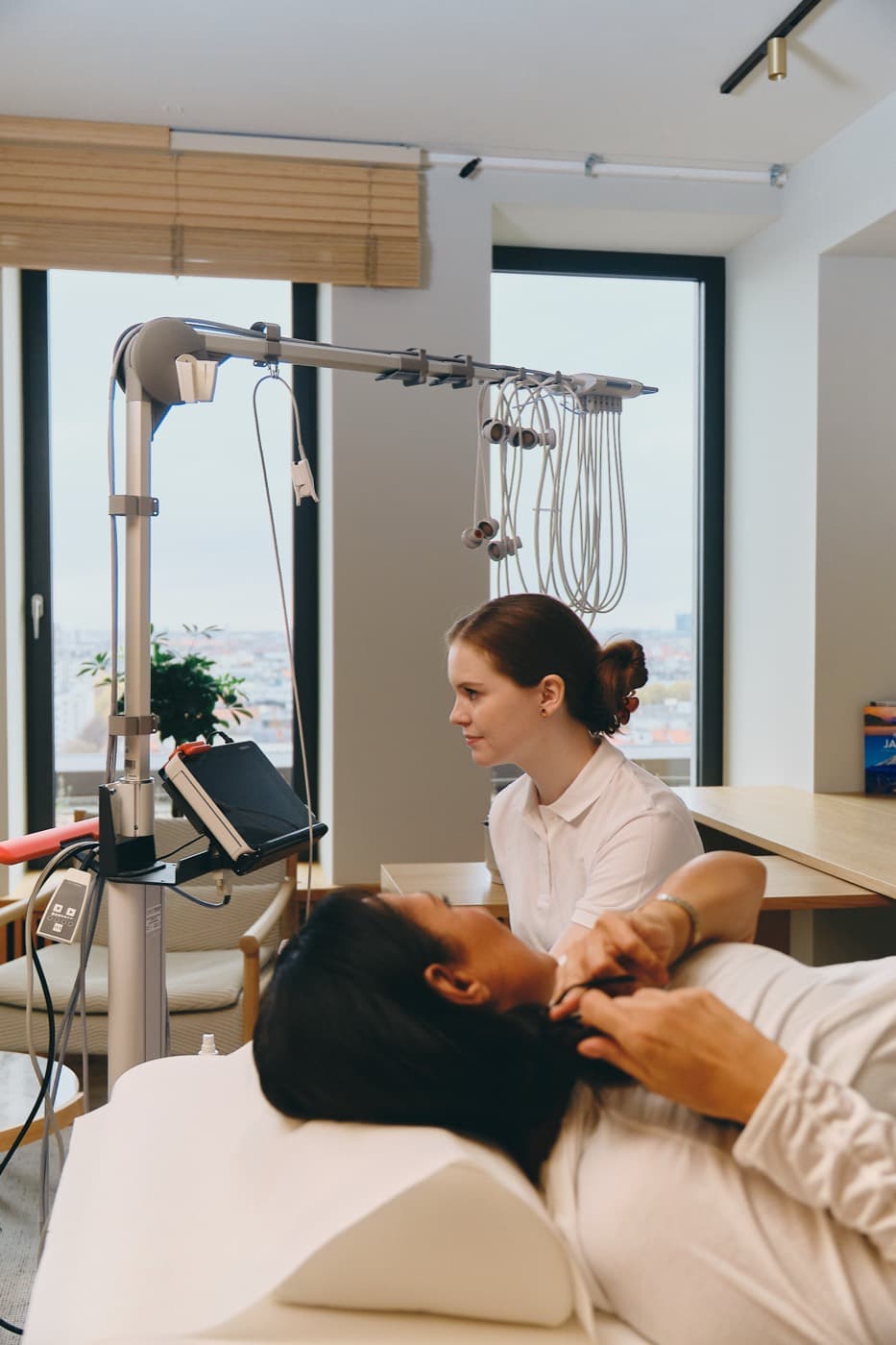
Whole-Body Check-Up
One day. One complete picture of your health.
25 functional examinations, 89 laboratory biomarkers and six hours in a clinic near Kurfürstendamm — assessed by specialist physicians and consolidated into a written prevention plan. From €1,900, billable under the German GOÄ fee schedule for privately insured patients.
- 25 functional examinations
- 89 to 230 biomarkers
- Findings discussed the same day
- 4.9 / 5 across 71+ reviews
In brief
What a whole-body check-up delivers
A whole-body check-up covers several organ systems in a single appointment instead of chasing them across months of specialist visits. The term is not protected: what is offered under it ranges from an extended blood panel to a multi-hour programme with cross-sectional imaging. What matters is less the number of examinations than whether someone consolidates the findings at the end and derives a decision from them. At YEARS that means 25 functional examinations, 89 laboratory biomarkers and 60 minutes of findings discussion with a specialist physician in one day in Berlin-Charlottenburg, concluded with a written prevention plan.
At a glance
- Duration
- 6 hours (Core), 9 hours (Evolve, Ultimate)
- Examinations
- 25 functional procedures at one location
- Laboratory
- 89 biomarkers (Core) up to 230 (Ultimate)
- Findings discussion
- 60 minutes with a specialist, same day
- Price
- from €1,900, GOÄ invoice for private reimbursement
- Location
- Joachimsthaler Straße 34, 10719 Berlin
Scope
What belongs in a whole-body check-up?
Five areas a comprehensive check-up should cover — and what YEARS uses for each.
Heart and vessels
Resting ECG, echocardiography, carotid ultrasound with Doppler, blood pressure and pulse wave measurement, cardiopulmonary exercise testing.
The area with the strongest evidence. Cardiovascular disease is the leading cause of death in Germany, and a large share of the risk factors is measurable and modifiable long before symptoms appear.
Laboratory
Full blood count, liver, kidney and thyroid values, HbA1c and insulin, complete lipid profile including ApoB and Lp(a), hsCRP, homocysteine, vitamin and mineral status, hormone panel.
ApoB and Lp(a) are where a comprehensive panel separates from standard laboratory work. Lp(a) is largely genetically determined and measured once in a lifetime — many people with elevated levels have no idea.
Lungs and performance
Body plethysmography, spirometry, diffusion capacity, cardiopulmonary exercise testing with VO2max, lactate diagnostics.
VO2max is among the strongest single predictors of life expectancy and at the same time readily modifiable through training. It almost never appears in standard check-ups.
Organs and imaging
Ultrasound of the abdomen, liver, kidneys and thyroid, body composition analysis, bone density measurement. Whole-body MRI from Evolve onwards.
Ultrasound reaches the abdominal organs well and works without radiation. For regions it cannot reach, MRI is added from Evolve onwards — with the qualification set out below.
Cognition and load
Cognitive testing, stress and sleep history, heart rate variability, validated questionnaires on sleep quality and perceived load.
The area most often missing from technically oriented programmes. Sleep and psychological load explain a considerable share of findings that otherwise remain unexplained.
What a programme should not contain matters just as much: procedures without a question produce findings without consequence. We therefore use imaging in stages rather than across the board.
Assessment
How far does "whole-body" actually reach?
The term promises a completeness no procedure delivers. The honest answer has three levels.
This reliably helps you
Guideline and endpoint basedBlood pressure, lipid profile including ApoB, HbA1c, kidney function, vaccination status, the established screening programmes (colonoscopy, mammography, skin cancer screening), cardiopulmonary exercise testing for VO2max.
For these procedures there are studies showing that people stay healthy longer as a result. Anyone with gaps here gains more from closing them than from any extended diagnostics.
This sharpens the picture
Contextual diagnosticsEchocardiography and vascular ultrasound without symptoms, extended biomarkers such as Lp(a), hsCRP and homocysteine, body composition, bone density, hormone panels.
These procedures improve risk assessment and frequently change a decision. Direct proof that using them without clinical indication reduces mortality is missing for most of them.
This is still open
Research-adjacentWhole-body MRI without clinical indication, liquid biopsy for cancer detection, epigenetic age estimation, microbiome analysis.
The systematic review in European Radiology (2025) covering 9,024 asymptomatic participants found a confirmed cancer diagnosis in 1.57 percent, alongside a high rate of incidental findings. We use these procedures and label them as research-adjacent.
This distinction is why we include whole-body MRI from Evolve onwards rather than as a standard for everyone. A procedure that finds something is not automatically a procedure that helps: what counts is whether the finding triggers an action that improves the course.
The full classification of every procedure is on our evidence page
Programmes
Which programme fits you?
Three levels of scope, the same sequence: diagnostics in the morning, findings discussion in the afternoon.
| Programme | Price | Duration | Biomarkers | Additionally included |
|---|---|---|---|---|
| Core | €1,900 | 6 hours | 89 | The complete baseline status: 25 functional examinations, ultrasound, exercise testing, prevention plan. |
| Evolve | €7,600 | 9 hours | 120 | Everything in Core plus whole-body MRI, liquid biopsy and one check-in over the following months. |
| Ultimate | €16,900 | 9 hours | 230 | Everything in Evolve plus epigenetics, neurology, microbiome analysis, three check-ins and a dedicated health manager. |
Core
€1,900
Duration · Biomarkers
6 hours · 89
The complete baseline status: 25 functional examinations, ultrasound, exercise testing, prevention plan.
Evolve
€7,600
Duration · Biomarkers
9 hours · 120
Everything in Core plus whole-body MRI, liquid biopsy and one check-in over the following months.
Ultimate
€16,900
Duration · Biomarkers
9 hours · 230
Everything in Evolve plus epigenetics, neurology, microbiome analysis, three check-ins and a dedicated health manager.
For privately insured patients and civil servants with Beihilfe we bill under the GOÄ fee schedule. Depending on the policy a substantial share is reimbursed, leaving an out-of-pocket amount well below the programme price.
Choosing
How do you recognise a good provider?
Five questions you can answer before booking — with any provider, including us.
Who assesses the findings, and are they named?
A check-up is only as good as the medical assessment at the end. If a provider page names no physician with qualification and career history, you cannot verify this. Our physicians are listed below, each with their own profile.
How much time is scheduled for the discussion?
Diagnostics is the easy part. The difference is made in the discussion: consolidating findings, weighing them against the history, setting priorities. Ask for the number of minutes. At YEARS it is 60 with a specialist physician.
What do you take away in writing?
A stack of laboratory printouts is not a result. What helps is a written plan that interprets the findings, names concrete steps and records what will be re-checked and when. Ours is delivered through the patient portal.
Are the limits of each procedure stated?
Providers who promote every procedure with equal confidence have either not done the assessment or are withholding it. For whole-body MRI, liquid biopsy and epigenetic clocks, the uncertainty belongs in the description, not in the small print.
Are prices and reimbursement transparent?
A programme price without stating what else may be charged is not a price. For privately insured patients that includes which GOÄ items are billed and what that means for submission.
The major check-up providers by name
The criteria above explain what to look for. Anyone searching in practice wants names. Here are four of the best-known providers in Germany, each with the details from their own website, plus where we fit in. One pattern stands out: the large groups work through location networks, we work from one site with more time per person.
| Provider | What it is | Locations | Check-up scope | What that means for you |
|---|---|---|---|---|
| YEARS | Physician-led prevention clinic, single site | Berlin-Charlottenburg | 25 functional examinations, 89 to 230 biomarkers, 6 to 9 hours, whole-body MRI from Evolve | 60 minutes of findings discussion with a specialist the same day, plus a written prevention plan. A single site means travel for anyone outside Berlin, but the same physicians over time. |
| Helios Prevention Center Source: helios-gesundheit.de | Prevention arm of a nationwide hospital group | Six sites plus two cooperation partners | Check-up over roughly six hours with laboratory, diagnostics, specialist consultation, fitness and nutrition advice | Describes itself as Germany’s leading prevention provider, with more than 10,000 check-ups a year. The network is the advantage when travel matters. |
| Conradia Medical Prevention Source: conradia-checkup.de | Prevention and check-up medicine with a radiology focus | Ten centres, including Berlin, Hamburg, Munich, Frankfurt, Cologne | Three tiers: internal-medicine check-up, optionally with whole-body MRI and extended imaging by risk | The most-awarded provider in the field: best check-up centre in the WirtschaftsWoche ranking 2023 and 2024, Deutschlands Beste 2026. Strong in imaging; combining it with functional diagnostics is a different approach from ours. |
| Sana Prävention Source: sana-praevention.de | Prevention offering of a nationwide clinic group | Six sites: Hamburg, Dusseldorf, Frankfurt, Karlsruhe, Munich (two) | Full-day check-up with laboratory, ultrasound of neck, thyroid, heart and abdomen, stress ECG, lung function, performance diagnostics | States it schedules at most two clients per physician per day. The examination scope is close to our Core programme; follow-up over time is handled differently. |
| radprax Vorsorge-Institut Source: radprax-vorsorge.de | Radiology-based screening institute, part of Quartz Healthcare Group | Dusseldorf | Whole-body check with 3-Tesla MRI, extendable with cardiac stress testing, prostate and breast MRI, and endoscopy | The focus is imaging in a single day. If you mainly want the scan, this is close to the source; a broad biomarker panel is not part of a radiology service catalogue. |
Third-party details as published on the providers own websites, as of 15 September 2026. We deliberately do not quote third-party prices: they change constantly, and a comparison page with outdated prices helps nobody.
Medical team
Who examines you?
Specialists in internal medicine and cardiology — named, with career history and individual profiles.
Dr. med. Raphael Finn
Specialist in Internal Medicine & Cardiology
Doctor-medic Alexandru Ardelean
Specialist in Internal Medicine
Dr. med. Ann Netzer
Specialist in Internal Medicine
Dr. med. Sebastian Kuss
Specialist in Internal Medicine
Dr. med. Hani Al-Mohamed
Specialist in Internal Medicine | Geriatric Medicine
The full team including medical assistants, laboratory and operations is on the team page
Suitability
When does a whole-body check-up make sense?
Some constellations clearly benefit from a comprehensive programme — in others, less is more.
The full programme pays off here
Family history with early onset
Heart attack, stroke or cancer in parents or siblings before the age of 60 shifts the pre-test probability considerably. A broad assessment provides a basis for decisions that a baseline panel cannot deliver.
Values that lifestyle does not explain
Abnormal liver values without alcohol, exhaustion despite good sleep, weight gain on an unchanged diet. When the obvious explanation does not hold, a broad search is justified.
A complete status in a single day
Anyone who cannot fit six specialist appointments into four months gains real time from bundling them. That is an organisational argument rather than a medical one — it is still a good one.
A baseline for the years ahead
Many markers only become meaningful over time. A carefully established baseline at 40 makes every later measurement interpretable, because individual normality is then known.
Primary care is enough here, for now
Under 30, no family history, no symptoms
Blood pressure, lipids, HbA1c, kidney function and vaccination status cover the relevant ground and are paid for by statutory insurance. The yield of a comprehensive programme is low in this group.
The basic factors are still open
Anyone who smokes, sleeps less than six hours or barely moves gains more from changing those than from any extended diagnostics. The programme does not replace that work, it measures it.
The screening programmes have not been used
Colonoscopy, mammography and skin cancer screening have the strongest evidence in the entire field and cost statutory patients nothing. They come first, not as an add-on to a self-pay programme.
There is a specific question
With a clear symptom, targeted specialist investigation is the faster and more precise route. A check-up is designed for the symptom-free state, not as a substitute for diagnostics with an indication.
If you are unsure which of the two columns applies to you: that is exactly what the initial consultation is for. It is free and takes 20 minutes.
Common questions about the whole-body check-up
A whole-body check-up is a comprehensive preventive examination that covers several organ systems in a single appointment instead of spreading them across individual specialist visits. It typically includes a detailed medical history, physical examination, a broad laboratory panel, cardiac diagnostics with ECG and ultrasound, vascular diagnostics, lung function testing, abdominal and thyroid ultrasound, and body composition analysis. The term is neither protected nor standardised: what providers mean by it ranges from an extended blood panel to a multi-hour programme including imaging. At YEARS the check-up covers 25 functional examinations and 89 laboratory biomarkers in one day, assessed by physicians and consolidated into a written prevention plan.
The range in the German market is wide because the term is not defined. Laboratory-only packages start in the low hundreds, comprehensive private programmes including imaging run into four and five figures. Three factors drive the price: whether cross-sectional imaging is included, how much physician time is scheduled for discussing the findings, and how broad the laboratory panel is. At YEARS, Core costs €1,900 with 89 biomarkers and 6 hours on site, Evolve €7,600 adding whole-body MRI, liquid biopsy and 120 biomarkers, Ultimate €16,900 with 230 biomarkers plus epigenetics, neurology and microbiome analysis. Privately insured patients submit a GOÄ-compliant invoice and are reimbursed for a substantial share depending on their policy.
A complete same-day check-up takes between four and nine hours depending on scope. At YEARS it is six hours for Core and nine for Evolve and Ultimate, including breaks and meals. The sequence is fixed: fasting blood draw and medical history in the morning, then functional diagnostics and imaging, and the findings discussion in the afternoon. That discussion is where programmes differ most visibly. At YEARS, 60 minutes with a specialist physician are reserved for it. Laboratory values with longer turnaround and the MRI report follow afterwards, and the written prevention plan is delivered through the patient portal.
Not necessarily, and the question is medically less clear-cut than marketing suggests. Whole-body MRI works without ionising radiation and detects findings ultrasound cannot reach. A systematic review in European Radiology (2025) covering 10 studies with 9,024 asymptomatic participants found a confirmed cancer diagnosis in 1.57 percent of cases. At the same time the evidence shows a high rate of incidental findings that trigger further workup without leading to treatment. Proof that whole-body MRI without clinical indication reduces mortality is still missing. At YEARS the MRI is therefore included from Evolve onwards and labelled as a research-adjacent procedure rather than a standard for everyone.
Statutory health insurance covers the health check-up defined by the Federal Joint Committee: every three years from age 35, once between 18 and 34, comprising medical history, physical examination, a small laboratory panel and urinalysis. The established screening programmes for skin cancer, colonoscopy and mammography are added within defined age groups. A comprehensive whole-body check-up goes beyond that and is self-pay. Privately insured patients and civil servants with Beihilfe are in a different position: services are billed under the GOÄ fee schedule and reimbursed in full or in large part depending on the policy. The remaining out-of-pocket share is then well below the programme price but depends on tariff and deductible.
No fixed threshold follows from the evidence, because risk profile matters more than year of birth. As orientation: from around 40, the likelihood rises that a comprehensive assessment finds something still amenable to change — cardiovascular risk markers such as ApoB and Lp(a), insulin resistance, early fatty liver. It becomes useful earlier with a family history of early-onset disease, with symptoms that have no explanatory finding, and with values that lifestyle does not account for. Below 30 and without predisposition, a primary-care baseline of blood pressure, lipids, HbA1c and vaccination status usually yields more than a comprehensive programme.
There is no evidence-based interval for the full package, though there is for its individual components. The established screening programmes have clearly defined intervals: colonoscopy every ten years, mammography every two years, skin cancer screening every two years. For laboratory values and functional diagnostics, the interval depends on the baseline finding. Anyone with unremarkable values and no particular risk profile gains little from annual repetition; every two to three years is usually sufficient. Anyone with an abnormal finding or actively working on specific values benefits more from targeted follow-up of individual markers than from repeating the entire programme. This assessment is part of the findings discussion.
Read on
Health check-up Berlin
The check-up as a programme: sequence, location and appointments in Berlin-Charlottenburg.
Whole-body MRI compared
Radiology centres, screening providers and clinics: who offers what, and what to watch for.
Check-up and private reimbursement
How GOÄ billing works and what privately insured patients typically get back.
Our evidence classification
Every procedure with its evidential weight, the reason we use it and an explicit note on what it cannot do.
Talk to us before you book
In the free initial consultation we spend 20 minutes working out which scope fits your history — and whether a comprehensive programme is the right thing for you right now.