
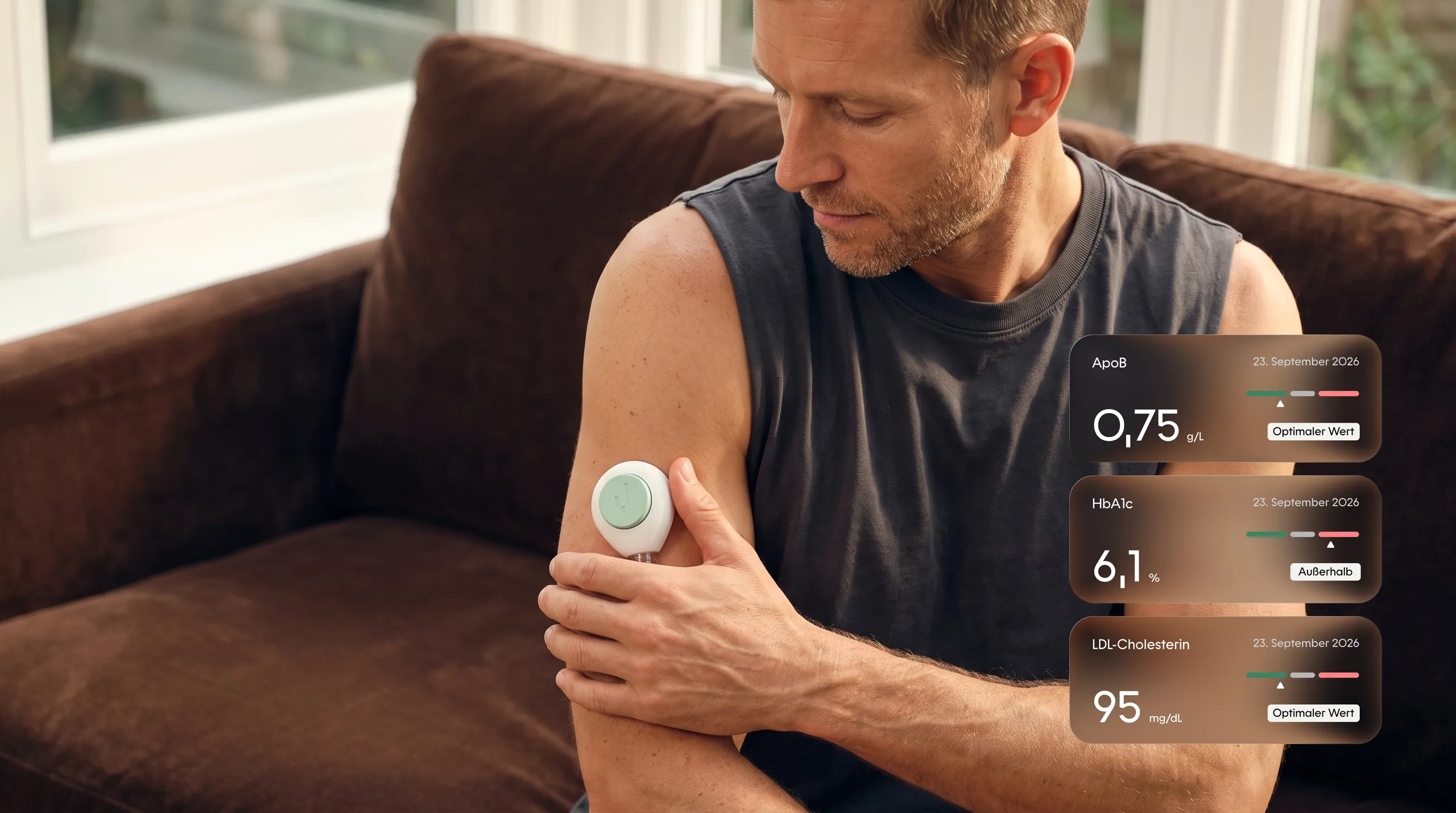
Check-in at home — cardiovascular
Your cardiovascular risk.
Measured, not estimated.
Most people know their cholesterol and nothing else. Yet the risk is decided by values that rarely appear in a standard lab panel: Lp(a), ApoB and high-sensitivity CRP. You measure them at home, the partner laboratory analyses the sample, and the medical interpretation is waiting in your YEARS portal.
Lp(a) once in a lifetime
genetically fixed, never needed again
From €169
one-off, no subscription, no commitment
Medically read
Findings in the portal, not a raw lab sheet
Who this is for
Four situations in which these values change something.
Cardiovascular disease is the leading cause of death in Germany, and most of the early stages run for decades without symptoms. Laboratory values are the only early access that does not require imaging equipment.
There was an early heart attack in your family
A heart attack or stroke in a parent or sibling before the age of 60 is the strongest pointer towards elevated Lp(a). The value is inherited, and if you never measure it you never find out.
Your cholesterol was “slightly elevated”
A single LDL value says little. ApoB counts the actual number of atherogenic particles, and in a subset of people it does not match the LDL — those are precisely the people whose risk is underestimated.
You changed something
Changed your diet, stopped smoking, started a statin. After eight to twelve weeks you can see whether it is working. Booking an appointment for that alone tends to push the measurement back by months.
Your last blood panel is years old
Without a concrete suspicion of disease, German statutory insurance generally does not pay for these values, and the three-yearly check-up covers only part of them. Lp(a) is never included there.
A panel does not replace a cardiology work-up and is not meant to. It answers the laboratory question, and it answers the whole of it rather than half.
How it works
Four steps, one of which takes two minutes.
From the postbox to the findings in the portal, everything runs without you. The sample itself is done in a few minutes.
 01
01The kit arrives by post
You receive a validated self-collection kit with instructions and a prepared return envelope. Nothing to buy or print yourself.
 02
02Take the sample at home
You place the device on your upper arm and press once. The blood then flows into the container by itself over a few minutes — no finger prick, no collecting drop by drop, and enough volume for a full laboratory panel rather than a handful of values. Then the sample goes into the return envelope and into the postbox.
 03
03The partner laboratory analyses it
The analysis runs at the partner laboratory to the same standards as a draw at the clinic. You do not need to follow anything up; we get in touch.
 04
04Results in the YEARS portal
Your values appear in your portal with a medical interpretation: what they mean in context, what has changed since the last measurement and what follows from it. Not a lab sheet for you to decode.

One value, one measurement
Lp(a) is genetically determined and barely changes across your life. Measure it once and you know it for good — and most people never do.
Panels and prices
Three panels, ordered by scope.
All three include ApoB and high-sensitivity CRP. Lp(a) sits in the two cardiovascular panels; the follow-up panel is the broader overview for the measurement after that. Prices include the laboratory work, the kit, return postage and the medical interpretation.
Cardiovascular basics
Labor-Panel: Lp(a)-Minimal-Screening
169 €
Order the kitThe smallest sensible entry point. Determine Lp(a) once in your life, plus the core values for lipid metabolism and blood sugar.
Parameters (7)
- Apolipoprotein B
- CRP high sensitive
- HbA1c
- HDL-Cholesterin
- LDL-Cholesterin
- Lipoprotein (a)
- Triglyceride
Cardiovascular screening
Labor-Panel: Lp(a)-Screening
185 €
Order the kitLike the basics, plus kidney function via cystatin C and the thyroid via TSH. Both change how the lipid values are read.
Parameters (9)
- Apolipoprotein B
- CRP high sensitive
- Cystatin C
- HbA1c
- HDL-Cholesterin
- LDL-Cholesterin
- Lipoprotein (a)
- Triglyceride
- TSH
Follow-up panel
Labor-Panel: Hausarzt-Verlauf
199 €
Order the kitThe standard panel for an interim check-in: lipid metabolism, blood sugar, liver, kidney, thyroid and vitamin D in one pass.
Parameters (11)
- (25-OH-)Vitamin D
- Apolipoprotein B
- CRP high sensitive
- Cystatin C
- GGT
- GPT (ALT, ALAT)
- HbA1c
- HDL-Cholesterin
- LDL-Cholesterin
- Triglyceride
- TSH
If Lp(a) has never been measured, one of the two cardiovascular panels is the right place to start. If it is known and unremarkable, you do not need it again — then the follow-up panel fits better.
What this is not
So the limits are clear.
No picture of the heart
Laboratory values show risk factors, not vessels. A CT calcium score, an echocardiogram, a stress ECG or a carotid ultrasound are not replaced by this. If the values point that way, we say so and refer you on.
Not a risk score
Laboratory values alone cannot produce a robust ten-year risk. Blood pressure, smoking status and a structured family history are missing for that. The interpretation says what the values mean, not what happens in ten years.
No diagnosis by post
Clearly abnormal values are reviewed by a physician, if needed with a venous check at the clinic or at your local doctor. A capillary value is a good starting point, not the final word.
Common questions about cardiovascular values at home
Lp(a) concentration is more than 90 percent genetically determined and stays largely stable across adult life. Unlike LDL it can barely be lowered through diet or exercise. This is why the European societies recommend a single measurement in every adult. If the value is unremarkable, the topic is settled. If it is elevated, it changes the targets for every other risk factor: LDL then has to be lowered more consistently, because the Lp(a) itself will not move.
LDL cholesterol measures how much cholesterol the particles carry. ApoB counts the particles themselves, and every single one can lodge in the vessel wall. In roughly one in five people the two do not match: the LDL looks acceptable while the particle count is high. That group is falsely reassured by an LDL value alone. Current guidelines therefore treat ApoB as the more reliable parameter, yet it is rarely part of a standard panel.
For triglycerides and blood sugar a fasting sample is considerably easier to interpret; for HbA1c, Lp(a) and ApoB it makes no difference. In practice: take the sample in the morning before breakfast and every value in the panel is cleanly usable. You receive the matching instructions with the kit so the measurement does not fail on a detail.
You receive the interpretation in the portal, and it says concretely what follows: whether the value needs a repeat, whether it belongs in a cardiology work-up, or whether it is unremarkable in the context of the others. For clearly abnormal single values we recommend a venous check before any consequence is drawn. We do not turn a single outlier into a diagnosis.
For effectiveness, yes: LDL, ApoB and triglycerides show after eight to twelve weeks whether the dose is sufficient. The follow-up panel additionally contains ALT and GGT for the liver. What the panel does not deliver is full tolerability monitoring — creatine kinase, which matters for muscle complaints under a statin, is in none of the panels. Always discuss dose changes with the physician who prescribed it.
As a private medical service we bill according to GOÄ, so reimbursement is possible depending on your policy. Privately insured patients submit the invoice to their insurer; with occupational health insurance the annual budget applies. German statutory health insurance generally does not cover laboratory values without a concrete suspicion of disease, and Lp(a) is not part of the check-up catalogue either. The insurer always decides bindingly.
Related
If your question is a different one.
All panels at a glance
Six panels ordered by scope, including the hormone and sport selections.
Read moreCardiac check in Berlin
When imaging and functional diagnostics are the question: ultrasound, ECG and stress testing on site.
Read moreFamily history
What a cluster of cases in your family means for your prevention, beyond the laboratory value.
Read moreAlready on Evolve or Ultimate?
Then the check-in is included — one with Evolve, three across the year with Ultimate. You do not need to order anything here; your kit comes through your programme. Core does not include check-ins, so if you booked Core you can add a single panel above.

Let us work out which panel makes sense at all.
A free intro call, 15 minutes. We look at what was measured last and what runs in your family. Honestly, even if the answer is that you do not need one right now.
★ 4,9 · 71+ Google-reviews · PKV, Beihilfe & bKV reimbursable