
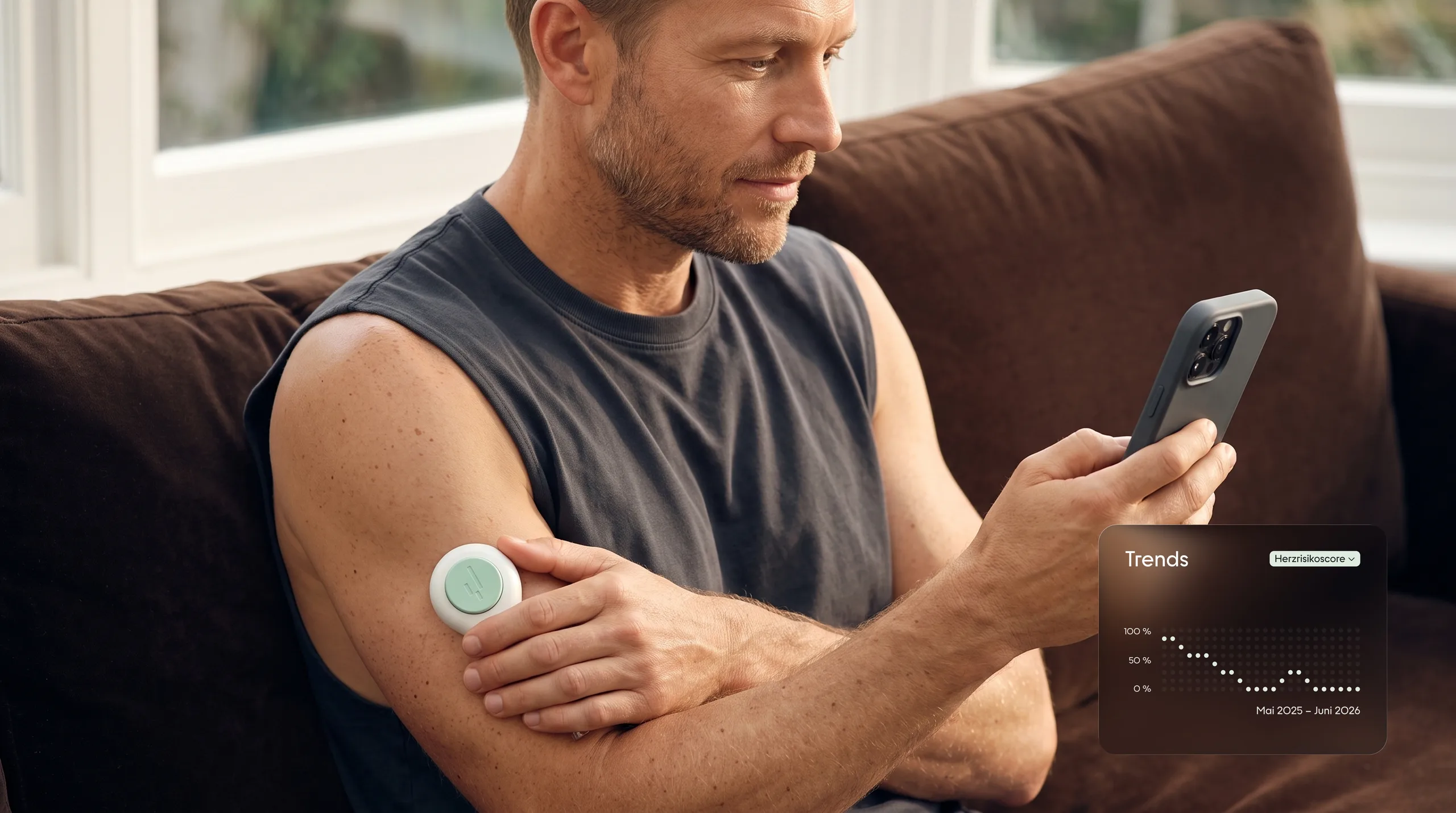
Check-in at home — training and load
Are you training hard
or training yourself into the ground?
Your training data tells you what you delivered. It does not tell you what the body paid for it. Metabolism, liver, thyroid, vitamin D and the hormone axis do — measured at home, in the week that matters to you, instead of at the next free appointment.
No break from training
Sample at home, the timing follows you
From €199
one-off, no subscription, no commitment
Medically read
Findings in the portal, not a raw lab sheet
Who this is for
Four situations in which blood values say more than the watch.
If you train in a structured way you already measure heart rate, power and sleep, which gives you a good view from the outside. What is missing is the view from the inside: whether metabolism and hormone axis are carrying the load or giving way. This page covers exactly that part, and it is open about the part it does not cover.
Performance stalls despite more training
More volume, the same or worse numbers. Before turning the training up further, it is worth looking at thyroid, vitamin D and hormones. Not every plateau is a training question.
You no longer recover
Resting heart rate up, HRV down, sleep worse, and that for weeks. A low testosterone relative to LH, or a suppressed thyroid picture, fits chronically low energy availability.
Before or after a hard season
Once before, once after, the same panel. Only the comparison shows whether a block of load left a mark — a single value in autumn says nothing about it.
You eat in a tightly controlled way
Calorie deficit, vegan or strongly restricted diet, weight class. That is the group with the highest risk of silent deficiencies, and vitamin D and B12 are the two that these panels cover at all.
What these panels do not contain is iron status — and in endurance sport that is the single most important value. What that means and how to get it anyway is below under “What this is not”.
How it works
Four steps, one of which takes two minutes.
From the postbox to the findings in the portal, everything runs without you. The kit waits at your place until the gap from training is right.
 01
01The kit arrives by post
You receive a validated self-collection kit with instructions and a prepared return envelope. Nothing to buy or print yourself.
 02
02Take the sample at home
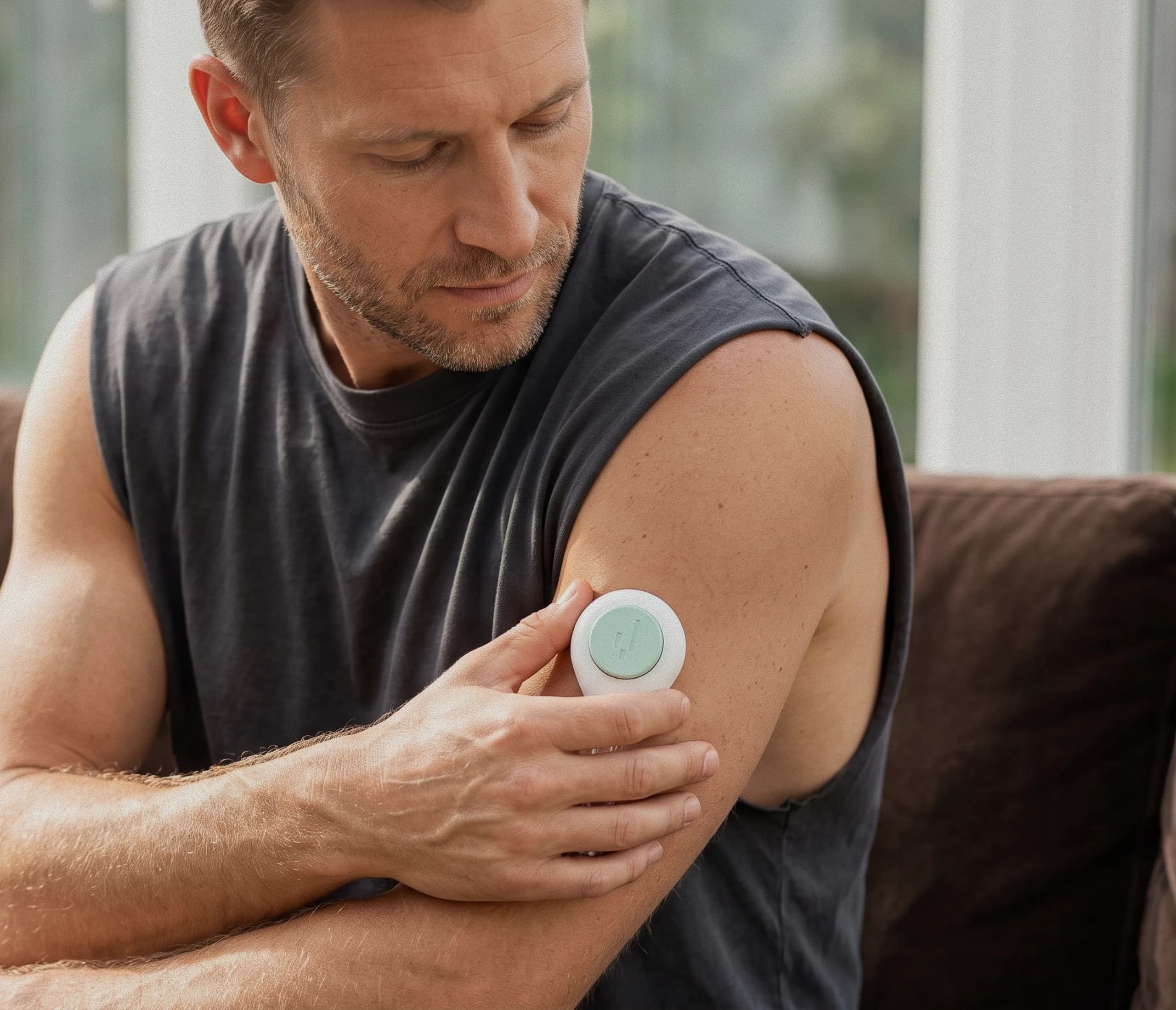
You place the device on your upper arm and press once. The blood then flows into the container by itself over a few minutes — no finger prick, no collecting drop by drop, and enough volume for a full laboratory panel rather than a handful of values. Then the sample goes into the return envelope and into the postbox.
 03
03The partner laboratory analyses it
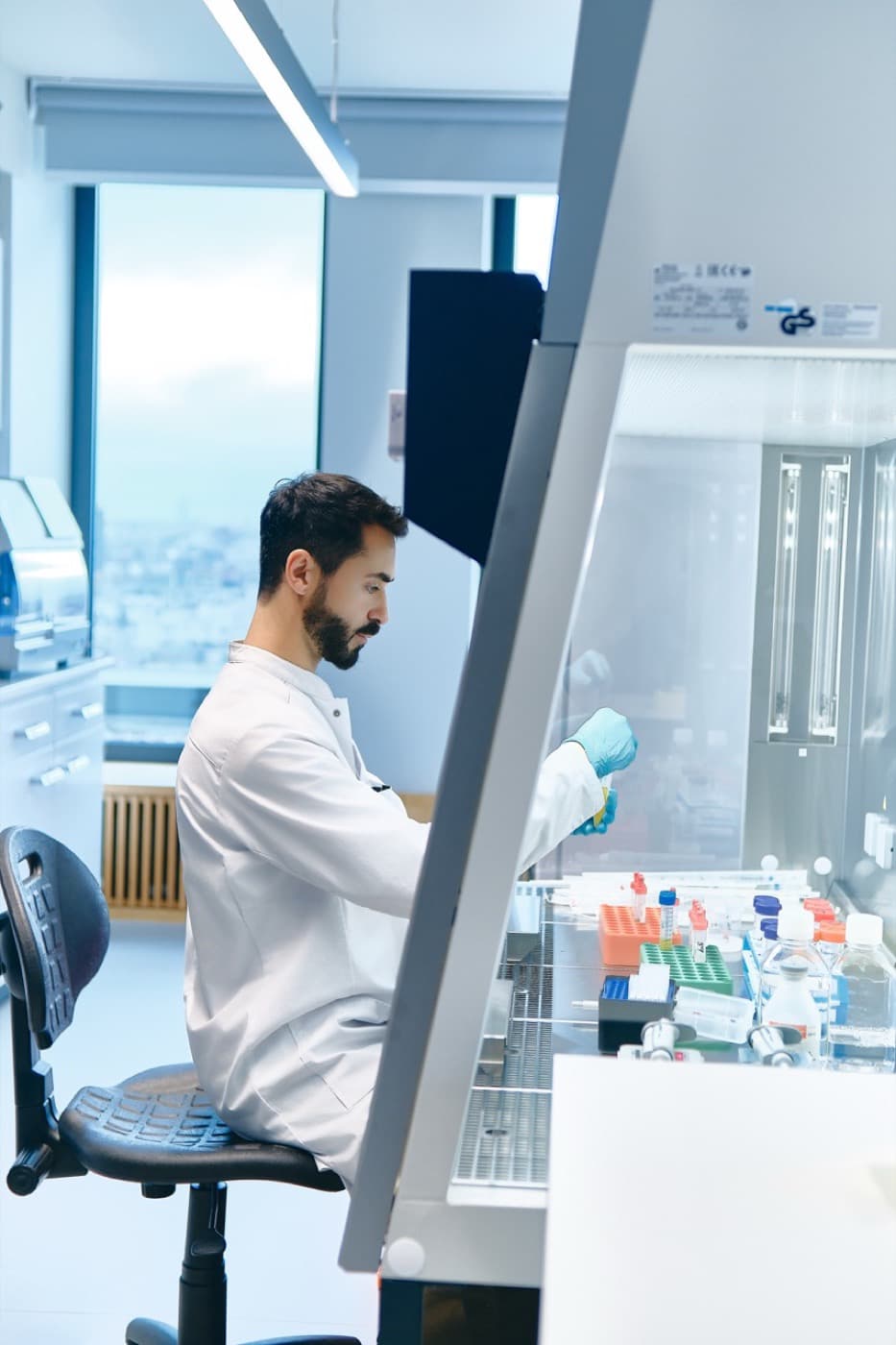
The analysis runs at the partner laboratory to the same standards as a draw at the clinic. You do not need to follow anything up; we get in touch.
 04
04Results in the YEARS portal
Your values appear in your portal with a medical interpretation: what they mean in context, what has changed since the last measurement and what follows from it. Not a lab sheet for you to decode.
A trend, not a snapshot
One value after the season tells you little. The same value before and after the season tells you what the season cost.
Panels and prices
Three panels: one for everyone, two for the hormone question.
The follow-up panel is the base and fits regardless of sex. If the hormone axis is also of interest, one of the other two panels applies depending on sex. Prices include the laboratory work, the kit, return postage and the medical interpretation.
Follow-up panel
Labor-Panel: Hausarzt-Verlauf
199 €
Order the kitThe standard panel for an interim check-in: lipid metabolism, blood sugar, liver, kidney, thyroid and vitamin D in one pass.
Parameters (11)
- (25-OH-)Vitamin D
- Apolipoprotein B
- CRP high sensitive
- Cystatin C
- GGT
- GPT (ALT, ALAT)
- HbA1c
- HDL-Cholesterin
- LDL-Cholesterin
- Triglyceride
- TSH
Women’s health, complete
Labor-Panel: Female Health Kit 2
229 €
Order the kitThe broad overview: metabolism, liver, kidney, thyroid, vitamin D and B12, plus estradiol and progesterone. Fewer hormones than the hormone profile, but the whole metabolism.
Parameters (13)
- (25-OH-)Vitamin D
- Apolipoprotein B
- CRP high sensitive
- Cystatin C
- Estradiol (E2)
- GGT
- HbA1c
- HDL-Cholesterin
- LDL-Cholesterin
- Progesteron
- Triglyceride
- TSH
- Vitamin B12
Hormone profile, men
Labor-Panel: Male Health
239 €
Order the kitTestosterone in the context of SHBG, albumin and the regulating hormones, plus lipid metabolism and HbA1c. Testosterone alone is rarely informative.
Parameters (14)
- Albumin
- Apolipoprotein B
- CRP high sensitive
- DHEAS
- Estradiol (E2)
- FSH
- HbA1c
- HDL-Cholesterin
- LDL-Cholesterin
- LH
- Prolaktin
- SHBG
- Testosteron
- Triglyceride
For a first pass the follow-up panel is almost always enough. The hormone panels make sense when recovery, libido, cycle or persistent exhaustion are the actual topic — and when you are prepared to draw a training consequence from the result.
What this is not
The gap you need to know about.
No iron status
Ferritin, transferrin and iron are in none of these panels. In endurance sport, for menstruating athletes and on a vegan diet this is the single most relevant value, and a deficiency begins long before haemoglobin falls. If that is your question you need a venous measurement — tell us in the intro call and we will sort out the route to it, rather than selling you a panel here that does not answer it.
No load markers
Creatine kinase, urea and magnesium are missing as well. Acute overload or muscle status after a hard block cannot be judged with this. What the panels show is the medium-term state of metabolism and hormones, not your condition after the last interval session.
No performance testing
Lactate step tests, spiroergometry and VO2max are measurements under load and cannot be done by post at all. If the question is training zones and thresholds, this is the wrong route — performance testing in Berlin exists for that.
Common questions about blood values in training
Because our partner laboratory currently does not offer it in the self-collection panels. That is the honest answer, and we write it down rather than papering over the gap. For athletes, iron status is the most important laboratory value there is: a falling ferritin degrades endurance performance and recovery long before anaemia becomes visible in a blood count. If that is your question, we plan a venous measurement, either as part of a check-up or through your GP. Buying a panel that does not answer your question would be money thrown away.
At least 24 hours after a hard session, and after a race or a very long run better 48 to 72 hours. The main reason is high-sensitivity CRP: intense load drives it up temporarily, and the value is then indistinguishable from silent inflammation. ALT and GGT can also rise after unaccustomed load. An easy run the day before is uncritical. The practical advantage at home is exactly this: you place the sample in the week that suits, instead of taking whatever appointment you can get.
In the morning, ideally between seven and ten and before breakfast. Testosterone follows a marked daily rhythm and is considerably lower in the afternoon, so an afternoon value can hardly be interpreted. Context matters too: testosterone alone says little, and only together with SHBG, albumin, LH and FSH can you place whether a low value comes from the control system or from the testes. That is precisely why the hormone profile includes those values.
Only indirectly, and one should be honest about that. Relative energy deficiency in sport is diagnosed clinically, not through a laboratory value. There is no marker that proves it. What the panels can contribute are findings consistent with the picture: a low testosterone alongside an unremarkable LH, a suppressed thyroid picture, a low vitamin D, and in female athletes an absent cycle with low estradiol. Those constellations are a reason to examine the balance of training and energy intake. An unremarkable panel, by contrast, does not rule an energy deficit out.
Worth measuring, yes; worth supplementing blindly, no. In Germany a large part of the population sits below the reference range through the winter half of the year, and anyone training mostly indoors or early in the morning is more likely to be among them. The evidence that raising levels in already sufficient people improves performance is weak. The sensible order is therefore to measure and then decide, rather than dosing on suspicion. Vitamin D sits in the follow-up panel and in the “complete” panel.
As a private medical service we bill according to GOÄ, so reimbursement is possible depending on your policy. Privately insured patients submit the invoice to their insurer; with occupational health insurance the annual budget applies. German statutory health insurance generally does not cover laboratory values used for training guidance, as there is no suspicion of disease. The insurer always decides bindingly.
Related
If your question is a different one.
All panels at a glance
Six panels ordered by scope, including the cardiovascular and hormone selections.
Read morePerformance diagnostics
When training zones are the question: lactate, spiroergometry and blood analysis in context, on site in Berlin.
Read moreVO2max test
Maximum oxygen uptake measured directly rather than estimated by your watch.
Read moreAlready on Evolve or Ultimate?
Then the check-in is included — one with Evolve, three across the year with Ultimate. You do not need to order anything here; your kit comes through your programme. Core does not include check-ins, so if you booked Core you can add a single panel above.
Let us work out which panel makes sense at all.
A free intro call, 15 minutes. We look at your training, at what was measured last and at whether your question fits a panel at all. If it is iron status, we will say so directly.
★ 4,9 · 71+ Google-reviews · PKV, Beihilfe & bKV reimbursable